


In today’s fast-paced market, organizations that embrace creative solutions gain a significant edge. As businesses navigate complex challenges, they must employ strategies that foster innovation, enhance customer experiences, and accelerate growth. Currently, teams are seeking new ways to solve problems by tapping into human-centered methods, rapid experimentation, and cross-disciplinary collaboration. In this article, we explore five powerful approaches that are transforming companies. These methods—Design Thinking, Brainstorming Accelerators, Lateral Thinking, Prototyping and Testing, and Cross-Functional Collaboration—offer a roadmap to fuel sustained success in today’s digital landscape. By integrating these frameworks, teams can uncover hidden opportunities, streamline processes, and build products that truly resonate with users. Whether you are a startup aiming to disrupt an industry or an established enterprise seeking continuous improvement, this guide will equip you with tools to spark innovation, measure impact, and nurture a culture where bold ideas flourish. Begin this journey now to unlock new growth pathways and stay ahead of competitors in an era defined by rapid change.
Embracing Design Thinking as a Catalyst for Innovation
Design Thinking is a structured, human-centered approach that prioritizes genuine user needs. By empathizing with real customers through interviews, observations, and surveys, teams gain deep insights into pain points that traditional analysis often overlooks. In this model, ideation follows empathy: diverse stakeholders generate a wide range of concepts, encouraging radical ideas alongside practical ones. Rapid prototyping then transforms abstract notions into tangible sketches or clickable mockups, allowing for early feedback loops. Testing these prototypes with actual users reveals unforeseen challenges and uncovers opportunities for improvement.
In today’s digital landscape, this iterative journey minimizes risk and aligns products closely with user expectations. For instance, a financial services firm applied Design Thinking to revamp its mobile app onboarding. By shadowing first-time users, the team discovered confusion around terminology and cumbersome verification steps. They streamlined the language, introduced contextual guidance, and created a low-fidelity prototype within days. After multiple testing cycles, the updated onboarding flow reduced drop-off by 45 percent and increased completion rates substantially.
Key steps include mapping the user journey, facilitating collaborative ideation sessions, and setting up feedback mechanisms for continuous refinement. By documenting every insight and iteration, teams build an institutional knowledge base that accelerates future projects. Organizations can also leverage online resources such as dschool.stanford.edu to access workshop materials and case studies. Ultimately, embedding Design Thinking within your workflow fosters a repeatable innovation engine where creative solutions flow naturally from deep user understanding.
Supercharging Brainstorming with Dynamic Accelerators
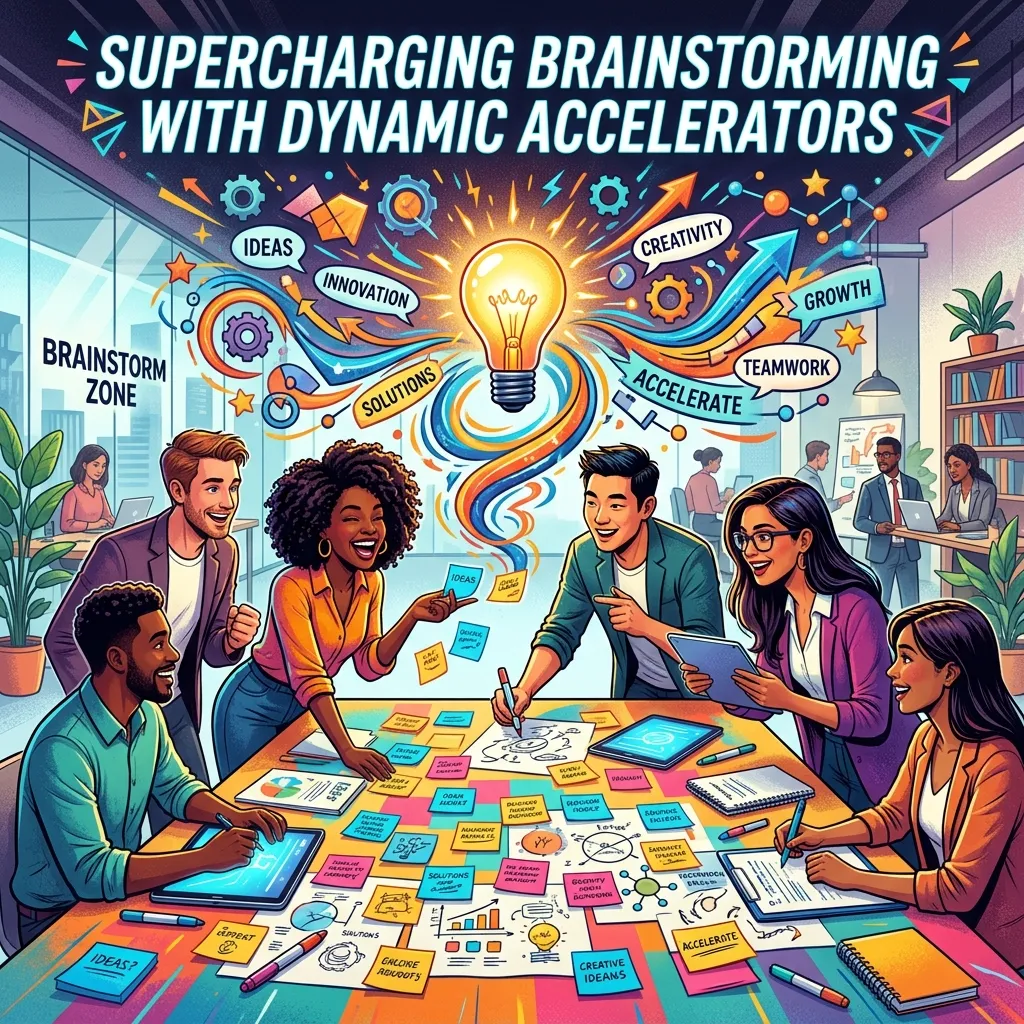
Traditional brainstorming often yields surface-level ideas due to groupthink or dominant personalities. To counter this, dynamic accelerators introduce structure and playful constraints that boost creativity. Techniques like timed idea sprints, role rotation, and improv-inspired ‘Yes, and’ rules break down mental barriers and encourage contributions from all participants. Begin by setting a strict 5-minute window during which each team member writes as many concepts as possible without judgment. Next, assign roles—one person acts as an end user, another as a skeptic, and a third as a visionary—to view ideas through varied lenses.
The ‘Yes, and’ method, borrowed from improvisational theater, prompts participants to build on one another’s suggestions rather than dismissing them. This creates a supportive environment where even wild notions are valued, often serving as springboards for more feasible innovations. Consider a software company aiming to enhance collaboration features. By running four improv-style brainstorming sessions, they generated ideas such as AI summarizers, virtual whiteboard pods, and modular communication hubs. Pilots of these concepts led to a 40 percent improvement in meeting efficiency and a 30 percent rise in overall satisfaction.
To implement these accelerators effectively, prepare clear prompts aligned with business challenges, rotate roles to explore fresh perspectives, and capture every idea without filtering. After the session, cluster similar suggestions and rate them against criteria like impact and feasibility. This ensures that the most promising creative solutions advance to prototyping stages. For more inspiration on advanced brainstorming tools, review research published by leading institutions such as nist.gov on collaborative innovation.
Harnessing Lateral Thinking to Break Assumptions
Lateral Thinking challenges conventional logic by encouraging teams to make unexpected connections. Developed by Edward de Bono, this approach disrupts habitual thought patterns, enabling breakthrough ideas that traditional methods overlook. One popular technique is random word stimulation: select a word at random—such as ‘harmony’ or ‘orchid’—and force connections between the word and the problem at hand. This exercise sparks novel associations that can lead to inventive product features or process improvements.
Another method involves provocative questions or ‘what if’ prompts designed to subvert existing constraints. Asking questions like ‘What if our service cost nothing?’ or ‘What if we offered support only at midnight?’ pushes teams to explore disruptive business models. For example, a logistics provider applied random word stimulation with ‘symphony’ and reimagined its routing algorithms to mimic orchestral balance. The result was a new scheduling system that evenly distributed workloads and improved on-time performance by 20 percent while reducing overtime costs.
To integrate lateral thinking, schedule dedicated creativity sessions separate from routine project meetings. Use online prompts or suggestion cards to guide discussions, and encourage a fearless mindset where even seemingly absurd ideas are shared. Document all outcomes and revisit them periodically; small sparks often ignite major innovations when combined with other methods like Design Thinking or prototyping. In today’s digital landscape, companies that master lateral thinking unlock a reservoir of creative solutions capable of transforming entire industries.
Iterative Prototyping and Rigorous Testing

An agile innovation cycle thrives on quick-turn prototypes and continuous validation. Instead of investing months in polished development, teams build a minimum viable product that highlights core value. This MVP is then released to a select group of users who provide both quantitative data (click-through rates, completion times) and qualitative insights (interviews, usability feedback). By cycling through build-test-learn loops, organizations can pivot rapidly, minimize wasted resources, and deliver features that resonate.
For example, a fintech startup launched a peer-to-peer payment feature within four weeks of ideation. They shared a clickable prototype with 50 beta testers, uncovering navigation blockers and trust concerns. Based on this feedback, the team refined the interface, clarified transaction confirmations, and added contextual tooltips. The enhanced version saw active usage climb by 60 percent and onboarding time drop by half.
To adopt this lean approach, establish a cross-functional squad empowered to make swift decisions. Use lightweight tools for rapid mockups, such as online wireframing platforms or basic code prototypes. Build simple dashboards that track critical metrics in real time, and schedule frequent demo sessions to share findings. This creates transparency and fosters a culture where every iteration informs the next phase. By embracing prototyping and testing as core practices, businesses embed a cycle of continuous improvement that fuels long-term growth.
AI-Powered Innovation Tools for Creative Solutions
In today’s fast-changing digital world, creative solutions are increasingly powered by artificial intelligence. AI helps organizations move beyond traditional problem-solving by enabling faster ideation, smarter decision-making, and highly personalized user experiences. When combined with human creativity, AI becomes a strong catalyst for innovation, allowing teams to test ideas quickly, reduce risks, and improve outcomes across different business areas. This shift is making AI an essential part of modern innovation strategies .
To successfully adopt AI for generating creative solutions, businesses must integrate it into their daily workflows, train teams to use AI tools effectively, and continuously evaluate performance. This ensures that AI supports—not replaces—human creativity while improving efficiency and innovation capacity.
Key Applications of AI for Creative Solutions
- AI-based idea generation for faster innovation cycles
- Predictive analytics for understanding customer needs
- Smart prototyping tools for rapid design creation
- Automation systems for workflow optimization
- Personalization engines to improve user experience
AI Tools and Their Role in Creative Solutions
| AI Tool Type | Application in Creative Solutions | Key Advantage |
|---|---|---|
| Generative AI Tools | Idea creation & content development | Speeds up innovation and brainstorming |
| Predictive Analytics Tools | Market trend forecasting | Improves strategic decision-making |
| AI Design Assistants | UI/UX prototyping | Enhances design speed and quality |
| Automation Platforms | Business process optimization | Saves time and reduces manual tasks |
| Personalization Engines | Customer experience enhancement | Increases engagement and conversions |
Cross-Functional Collaboration as a Driver of Creative Solutions
In modern organizations, creative solutions rarely come from a single department working in isolation. Instead, innovation emerges when diverse teams—such as marketing, design, engineering, sales, and customer support—collaborate closely to solve shared problems. Cross-functional collaboration brings together different perspectives, skill sets, and experiences, which helps teams identify blind spots and develop more complete and effective solutions. In 2026, this approach has become essential for companies aiming to stay competitive in fast-changing markets.
When teams work across departments, communication and alignment become key success factors. Clear goals, shared tools, and structured workflows help ensure that collaboration remains productive rather than chaotic. Regular feedback loops and transparent decision-making further strengthen the process, enabling faster execution of creative solutions with higher impact.
Benefits of Cross-Functional Collaboration
- Encourages diverse thinking and reduces bias
- Speeds up problem-solving and decision-making
- Improves product quality through shared expertise
- Enhances innovation through combined skill sets
- Builds stronger organizational alignment
Cross-Functional Collaboration Framework
| Stage | Action | Outcome |
|---|---|---|
| Planning | Define shared goals across teams | Clear direction and alignment |
| Ideation | Conduct joint brainstorming sessions | Wider range of ideas |
| Execution | Assign cross-team responsibilities | Faster implementation |
| Feedback | Collect insights from all departments | Continuous improvement |
| Optimization | Refine based on performance data | Stronger final output |
By integrating cross-functional collaboration into daily operations, organizations can unlock more scalable and impactful creative solutions that are both practical and innovation-driven.
Data-Driven Decision Making for Creative Solutions

In today’s competitive environment, creative solutions are no longer based only on intuition or experience—they are increasingly driven by data. Organizations that effectively use data can identify patterns, predict customer behavior, and make faster, more accurate decisions. This approach reduces guesswork and helps teams focus on what truly works, improving both innovation speed and business outcomes. Through concrete examples, practical tips, and references to leading research from authoritative sources such as dschool.stanford.edu and nist.gov, you will learn how to implement these creative solutions in your organization.
Data-driven decision-making combines analytics, user feedback, and real-time performance tracking to guide every stage of innovation. When teams understand what the data is saying, they can refine ideas early, avoid costly mistakes, and continuously improve their solutions. This method is becoming a core pillar of digital transformation strategies across industries.
Key Principles of Data-Driven Creative Solutions
- Use real-time data to guide decision-making
- Combine qualitative feedback with quantitative metrics
- Continuously test and validate ideas with analytics
- Focus on measurable outcomes instead of assumptions
- Adjust strategies based on performance insights
How Data Improves Creative Solutions
- Helps identify customer pain points more accurately
- Reduces risk in product development and innovation
- Improves targeting and personalization strategies
- Speeds up iteration cycles through clear feedback loops
- Enhances overall efficiency in problem-solving
By embedding data into every stage of innovation, organizations can create more reliable, scalable, and impactful creative solutions that align closely with real-world needs.
Driving Growth Through Cross-Functional Collaboration
Creative solutions often emerge when diverse expertise converges. Cross-functional collaboration unites teams from design, engineering, marketing, sales, and customer support to co-create holistic strategies. By hosting innovation workshops and using shared digital workspaces, organizations break down silos and encourage open dialogue. Rotating team assignments further exposes employees to different perspectives, enriching their problem-solving toolkit.
Consider an e-commerce company that formed a multidisciplinary team to optimize its returns process. In a week-long sprint, members from IT, logistics, finance, and customer service co-designed an AI-powered returns assistant. This tool guided customers through printing labels, scheduling drop-offs, and tracking refunds. The pilot cut return processing time by 50 percent and reduced support tickets by one-third, demonstrating the power of collective creativity.
To foster such collaboration, set clear objectives and roles, provide shared communication channels, and celebrate small wins publicly. Encourage teams to reference frameworks from reputable sources such as Harvard Business Review or relevant government research portals for best practices. Over time, this integrated approach cultivates a resilient innovation culture where creative solutions are not isolated events but everyday norms driving sustained performance.
Frequently Asked Questions
What is the primary benefit of Design Thinking?
Design Thinking focuses on understanding real user needs before building solutions. It ensures products are shaped around user behavior, pain points, and expectations.
This reduces the risk of market failure and increases adoption rates.
How do dynamic brainstorming accelerators differ from traditional sessions?
Dynamic brainstorming accelerators use structured techniques like time limits, role-play, and improvisation to stimulate creativity. Unlike traditional sessions, they reduce hesitation and prevent groupthink by encouraging rapid idea generation.
This results in more diverse, unconventional, and high-volume ideas.
When should we move from prototyping to full development?
Teams should move to full development when prototypes consistently meet key success metrics. These metrics may include usability scores, task completion rates, and positive user feedback.
Once major risks are validated and reduced, scaling development becomes a safer investment.
Why is user feedback important in Design Thinking?
User feedback ensures that solutions remain aligned with real needs and expectations. It helps identify usability issues early in the design process.
This continuous input improves product quality and reduces costly redesigns later.
What are the main stages of Design Thinking?
Design Thinking typically includes empathize, define, ideate, prototype, and test stages. Each stage focuses on understanding problems, generating ideas, and refining solutions.
The process is iterative, meaning teams may revisit stages multiple times.
How does Design Thinking reduce product failure?
It reduces failure by validating ideas early through user research and testing. Teams avoid building assumption-driven solutions that may not fit the market.
This leads to more relevant and user-centered products.
What role does prototyping play in innovation?
Prototyping allows teams to quickly visualize and test ideas before full development. It helps identify flaws, gather feedback, and refine concepts efficiently.
This reduces risk and improves final product quality.
Why is collaboration important in brainstorming sessions?
Collaboration brings together diverse perspectives and experiences. This increases the likelihood of generating innovative and practical ideas.
It also helps teams refine concepts more effectively through discussion.
How do success metrics guide product development?
Success metrics provide measurable benchmarks for evaluating progress and performance. They help teams determine whether a solution is meeting user needs effectively.
These metrics guide decisions on whether to iterate or scale a product.
What challenges exist in group ideation sessions?
Common challenges include groupthink, lack of participation, and dominant voices overshadowing others.
Time pressure or unclear objectives can also limit creativity.
Structured techniques help overcome these barriers.
How can teams improve idea quality in brainstorming?
Teams can improve idea quality by encouraging open participation and using structured ideation methods. Setting clear goals and constraints also helps focus creativity.
Rapid feedback and iteration further refine ideas into stronger solutions.
What makes Design Thinking different from other frameworks?
Design Thinking is highly user-centered and iterative, unlike more rigid or purely analytical frameworks. It emphasizes empathy, experimentation, and continuous feedback.
This makes it especially effective for solving complex, human-focused problems.
Conclusion
In today’s rapidly evolving business environment, adopting creative solutions is essential for maintaining competitiveness and sparking growth. By leveraging Design Thinking, dynamic brainstorming accelerators, lateral thinking, rapid prototyping, and cross-functional collaboration, organizations build a robust innovation engine. These methods encourage empathy, experimentation, and diverse perspectives, ensuring that each new idea is grounded in real-world insights and refined through continuous feedback. Remember to define clear metrics, communicate successes, and celebrate learning moments to reinforce a culture that values ingenuity. Start small: choose one strategy, run a focused pilot, and measure results. As you gain momentum, integrate additional practices to create an ecosystem where bold ideas flourish seamlessly. By committing to this journey today, you position your business to adapt, thrive, and lead in an era defined by constant change.
