



In today’s fast-paced digital world, breakthrough creative solutions depends on structured creativity, collaboration, rapid experimentation, and AI integration. This guide explores practical strategies to transform constraints, improve problem-solving, and build sustainable organizational innovation systems effectively today.
In today’s digital landscape, organizations across sectors recognize that driving breakthrough innovation is not optional; it’s vital for long-term success. As we navigate fast-moving markets and ever-evolving customer expectations, creative problem-solving becomes the engine that powers growth, differentiation, and resilience. Whether you oversee a lean startup, manage a multinational corporation, or guide a mission-driven nonprofit, harnessing structured approaches to stimulate fresh ideas can transform complex challenges into game-changing opportunities.
This comprehensive guide distills ten proven strategies into five thematic sections, each offering actionable steps you can adopt immediately. We’ll explore how to turn limitations into advantages, leverage human-centered techniques like design thinking and co-creation, foster an experimentation culture, tap into advanced technologies, and embed creative habits that sustain momentum. Along the way, we’ll reference reputable resources—from the National Science Foundation to the Stanford d.school—to ground practices in research and real-world success stories. By integrating these approaches, your organization will cultivate a reliable system for generating, testing, and scaling inventive solutions.
Grab your team’s attention, set clear goals, and get ready to unlock the creative potential lying dormant in every individual. In just a few focused sprints, you’ll not only accelerate ideation but also ensure that innovative concepts materialize into impactful products, services, or processes. Let’s dive into the first cluster of tactics that turn constraints and empathy into the seeds of breakthrough innovation.
Harnessing Constraints and Human-Centered Workshops
Embrace Constraints to Stimulate Creativity
At first glance, limiting resources may seem counterproductive. Yet, setting strict boundaries—on budget, time, or materials—can compel teams to think beyond obvious solutions and tap into unconventional pathways. This approach, rooted in engineering disciplines, encourages designers and problem solvers to prioritize essentials and discard unnecessary complexity.
To start, define clear parameters for your challenge. For example, impose a 48-hour deadline to develop a working prototype or cap spending for an internal innovation contest at a nominal amount. Once limits are in place, ask participants to generate as many concepts as possible without judgment. Next, evaluate ideas against your constraints and select top candidates for rapid mock-ups—using low-fidelity tools such as cardboard, paper sketches, or simple digital wireframes. By forcing your team to focus on core functionality, you’ll often uncover elegant, high-impact solutions that might get lost in open-ended scenarios.
This tactic is particularly effective when combined with rapid iteration. After each trial, gather feedback, tweak your approach, and refine prototypes. You’ll find that necessity not only fuels creativity but also accelerates decision-making, limiting time spent on peripheral features and boosting overall productivity.
Leverage Design Thinking Workshops
Design thinking offers a structured, human-centered framework that drives deep insight into user needs and rapid solution generation. Structured workshops, often hosted by innovation teams or external facilitators, guide cross-functional groups through five stages: empathize, define, ideate, prototype, and test.
Begin by assembling a diverse team of 6–10 individuals—drawing from product, marketing, customer service, and technical roles. Provide materials such as sticky notes, whiteboards, and basic prototyping supplies. First, run empathy exercises: conduct interviews or map user journeys to surface unmet needs. Summarize these findings into clear problem statements. Next, launch ideation sessions using techniques like “Crazy Eights” (sketching eight ideas in eight minutes) or SCAMPER (Substitute, Combine, Adapt, Modify, Put to another use, Eliminate, Reverse).
Once you have a pool of concepts, transition quickly to prototyping. Build simple models—paper interfaces, click-through mockups, or rudimentary physical constructs—and test them with real or simulated users. Capture their reactions, iterate, and refine. This cycle condenses months of development into days or weeks, significantly lowering risk and ensuring alignment with genuine customer pain points. For further guidance, explore Stanford d.school’s resources at https://dschool.stanford.edu.
Visual Mapping and Cross-Functional Collaboration

Adopt Mind Mapping for Divergent Thinking
Mind mapping mirrors the brain’s associative nature by placing your central challenge at the center of a canvas and radiating related ideas outward. This visual format breaks linear thought patterns and encourages participants to forge unexpected connections across themes.
Begin each session with a concise problem statement. Draw primary branches for major domains—such as user experience, technical feasibility, and market dynamics—then add sub-branches with specific ideas, questions, or data points. Use color-coding to group related thoughts and emphasize high-priority areas. When the map is complete, analyze clusters to identify promising pathways. Extract and assign action items, ensuring that no innovative spark fades away. Digital tools like XMind or MindMeister also enable remote teams to co-create and expand mind maps in real time, fostering continuous ideation even outside dedicated workshops.
Foster Cross-Functional Innovation Pods
Creativity flourishes when diverse expertise converges. Siloed departments often miss holistic solutions that emerge at the intersections of design, engineering, marketing, and customer insights. By forming cross-functional pods, you enable teams to leverage multiple perspectives and accelerate problem resolution.
Set up small, dedicated squads that meet regularly—weekly or bi-weekly—to tackle specific challenges. Rotate membership periodically to inject fresh viewpoints and prevent groupthink. During ideation sessions, assign roles such as “Devil’s Advocate” to challenge assumptions and “User Champion” to represent customer interests. Capture all discussions in shared collaboration platforms like Confluence or Miro, allowing asynchronous contributions and maintaining transparency. Over time, these pods become incubators for breakthrough innovation, empowering your organization to adapt swiftly to market changes and complex scenarios.
Rapid Experimentation and a Culture of Learning
Implement Rapid Prototyping & Testing
Traditional phased development models often lead to lengthy cycles and late-stage failures. A lean approach, centered on rapid prototyping, mitigates these risks by validating assumptions early and iterating based on real user feedback.
Identify the core feature that addresses your target need and create a low-fidelity prototype—this could be a clickable mockup, a paper sketch, or a simple physical model. Recruit a small group of representative users (5–7) and observe them interacting with your prototype. Take detailed notes on their behaviors, frustrations, and workarounds. Use these insights to refine your design in short sprints, typically one to two weeks in length. By the time you undertake a full production build, you’ll have already ironed out major usability issues and aligned your solution with genuine user expectations.
Champion a Fail-Fast, Learn-Fast Mindset
Fear of failure is innovation’s greatest adversary. In an environment where experimentation is encouraged—even when outcomes are uncertain—teams pursue bold ideas and discover novel solutions more rapidly. To embed this mentality, publicly celebrate experiments, regardless of outcome. Share learnings through post-mortem sessions rather than attributing blame.
Consider introducing “failure awards” or monthly “experiment spotlights” to honor teams that took calculated risks. Provide a sandbox environment with test data and isolated infrastructure so that staff can prototype freely without jeopardizing live systems. Document critical insights in an accessible knowledge base, turning every setback into a stepping stone. Over time, this culture of psychological safety fuels continuous improvement and supports sustainable breakthrough innovation.
Co-Creation, AI Integration, and Creative Rituals

Engage Customers in Co-Creation
Customers are not just end users; they are invaluable co-creators whose insights can guide more relevant, high-impact solutions. By involving them directly in the ideation and development process, you ensure your innovations address real-world pain points and foster deep loyalty.
Launch pilot programs or open innovation challenges where participants submit ideas or vote on proposed features. Host virtual hackathons or focus groups that pair customers with internal teams. Offer incentives—discounts, early access, or public recognition—to encourage active participation. Keep contributors informed about how their feedback shapes your roadmap. This collaborative approach accelerates adoption, builds a community of brand advocates, and strengthens customer relationships in a manner supported by the National Science Foundation’s user-centered research principles (nsf.gov).
Integrate AI Tools as Creative Partners
Advances in artificial intelligence and machine learning are transforming how teams brainstorm, design, and iterate. Generative design platforms can optimize hundreds of layout permutations, while AI writing assistants expedite content ideation and refinement.
Begin with a technology audit to identify repetitive tasks—data analysis, routine drafting, or pattern recognition—that can be augmented by AI. Incorporate tools like GPT-based assistants for rapid content outlines or computer vision platforms for visual design analysis. Leverage predictive analytics to anticipate emerging trends and guide strategic prioritization. Ensure ethical oversight by validating all AI outputs through human review. When deployed responsibly, AI becomes a multiplier for human creativity, enabling faster cycles of experimentation and more sophisticated breakthroughs.
Creative Solutions: Turning Problems into Opportunities
In today’s fast-changing digital world, creative solutions are what separate average teams from high-performing innovators. Instead of reacting to problems the same way every time, organizations that focus on creative solutions are able to rethink challenges, break patterns, and discover smarter, faster, and more efficient ways to move forward. The real power of creative solutions is not just in generating ideas, but in applying those ideas in practical, real-world situations that actually deliver results.
When teams consistently apply creative solutions, they stop seeing limitations as blockers and start treating them as opportunities for innovation. This mindset shift helps businesses improve products, reduce costs, enhance customer experience, and stay ahead of competitors even in uncertain markets.
Key Characteristics of Creative Solutions
- Focus on solving the real problem, not just symptoms
- Combine ideas from different industries or disciplines
- Encourage experimentation and rapid testing
- Use constraints as inspiration instead of limitations
- Prioritize user needs and real-world feedback
- Balance innovation with practical execution
Creative Solutions in Action (Real Comparison )
| Problem Situation | Traditional Response | Creative Solutions Approach |
|---|---|---|
| Low customer engagement | Increase ads budget | Redesign user experience + personalization |
| Slow product delivery | Hire more staff | Automate workflow + optimize process |
| High operational cost | Cut features | Re-engineer process with smarter tools |
| Poor user retention | Discount offers | Improve onboarding + user journey |
| Market competition | Lower pricing | Differentiate with unique value proposition |
Why Creative Solutions Matter More Than Ever
- They help businesses adapt quickly to change
- They reduce dependency on outdated methods
- They unlock innovation even with limited resources
- They improve decision-making through experimentation
- They create long-term competitive advantage
Final Insight
At the end of the day, creative solutions are not about doing something completely new every time—they’re about thinking differently, combining ideas better, and executing smarter. Teams that consistently invest in creative solutions don’t just solve problems—they build systems that continuously generate better outcomes.
Embedding Creativity into Daily Workflows
Establish Regular Creative Rituals
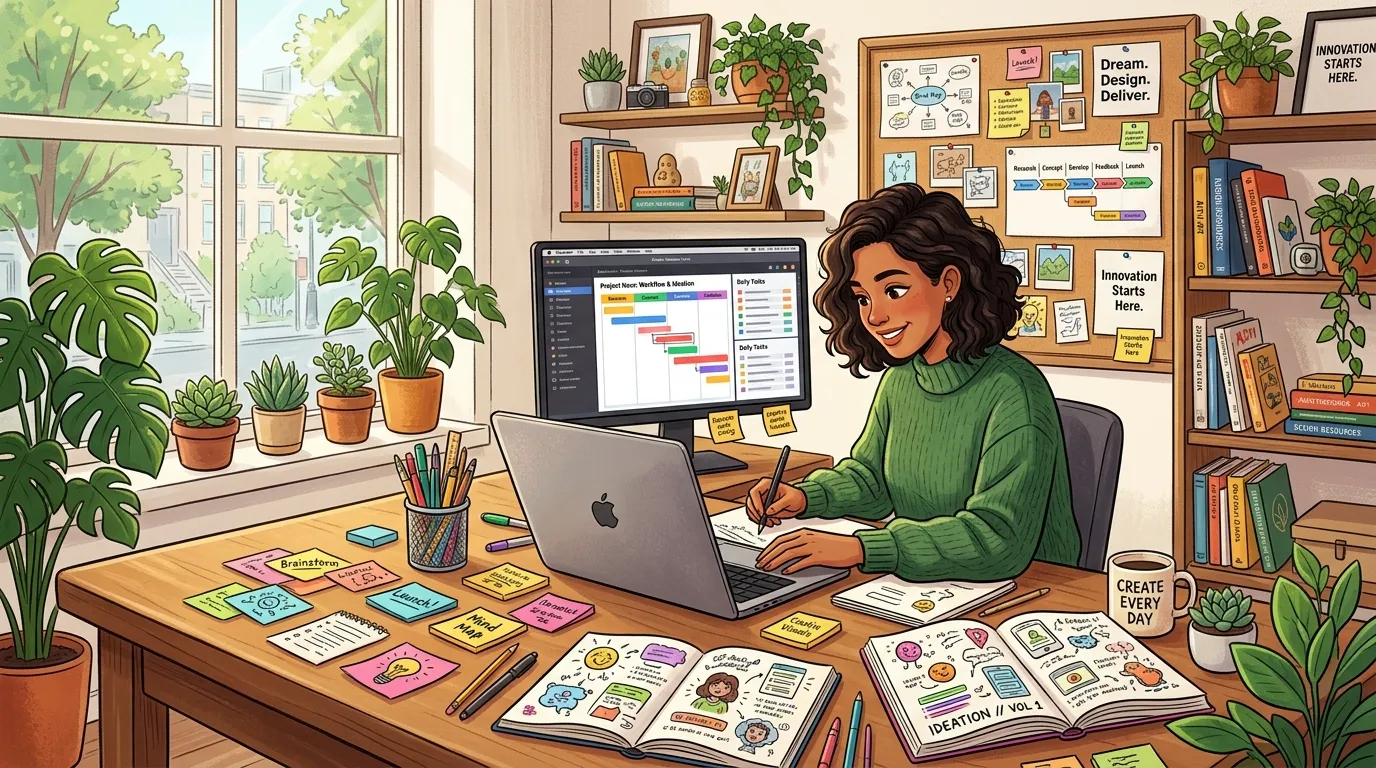
Innovation thrives on consistency. By weaving structured practices into your daily routine, you signal to every team member that creativity is a priority. Consider scheduling weekly ideation sessions, monthly hack days, or short daily brainstorming stand-ups where participants share quick insights or challenges.
Allocate dedicated “innovation hours” free from meetings and routine tasks. Encourage employees to spend up to 20% of their time on passion projects or skill-building activities. Maintain a virtual or physical “idea wall” for spontaneous submissions. Rotate session facilitators and experiment with varied formats—lightning talks, silent brainstorming, or fishbowl debates—to maintain energy and engagement. Over time, these habits create an organizational rhythm that sustains momentum even during peak operational pressures.
Measure Progress and Iterate Continuously
Creative initiatives must deliver tangible impact. Define clear KPIs—time-to-prototype, user satisfaction scores, adoption rates, or revenue uplift—and track them through interactive dashboards. Review metrics regularly (monthly or quarterly) to evaluate the effectiveness of your innovation pipeline.
Use data-driven insights to pivot away from underperforming experiments quickly, reallocating resources to higher-potential projects. By embedding a feedback loop into every cycle, you transform creative endeavors from one-off bets into a disciplined, scalable engine for growth. In an era where agility dominates competitive advantage, this systematic approach ensures your organization remains at the forefront of breakthrough innovation.
In today’s fast-evolving environment, relying on chance ideas is insufficient. By embracing constraints, leveraging human-centered methodologies, fostering cross-functional collaboration, and integrating cutting-edge tools like AI, you build a robust framework for breakthrough innovation. Regular creative rituals and a culture that celebrates smart failures further sustain the momentum needed to navigate uncertainty.
Begin by selecting one or two strategies—perhaps a rapid prototyping sprint or an AI-powered brainstorming session—and launch a small pilot. Document your learnings, measure outcomes against your KPIs, and iterate. As success stories accumulate, scale these practices across teams and embed them into your organizational DNA. When creativity becomes a habitual priority rather than an afterthought, your organization will continually deliver high-impact solutions that delight customers and outpace competitors and beyond.
