



Creative Breakthrough Solutions drive innovation through divergent thinking, collaboration, constraints, and technology. By applying structured strategies and fostering a growth mindset, organizations can transform complex challenges into scalable, high-impact opportunities and long-term competitive success.
Organizations face immense pressure to deliver Creative Breakthrough Solutions that address complex, multifaceted challenges. Rapid technological advances, shifting customer expectations, and global competition make it absolutely vital to cultivate a systematic approach to continuous innovation. A well-defined framework accelerates idea generation and ensures that raw concepts evolve into practical, profitable implementations.
We will examine seven foundational strategies that drive creative innovation. From fostering expansive thinking and highly collaborative environments to leveraging tight constraints and modern technology, you will learn how to sustain momentum with a growth mindset. You will discover actionable strategies to unlock your team’s true potential. Whether you are launching a new product, refining a service, or reimagining organizational processes, these principles empower you to transform obstacles into opportunities for growth. You will learn to embed Creative Breakthrough Solutions at the very heart of your business initiatives.
The Foundation of Creative Breakthrough Solutions
Creative Breakthrough Solutions do not happen by accident. They require a deliberate, structured environment where innovation can thrive. When we talk about creative innovation, we mean moving beyond incremental changes and seeking entirely new paradigms. Traditional problem-solving often relies on past precedents, while Creative Breakthrough Solutions demand fresh perspectives and a willingness to challenge the status quo.
To understand the difference, we must look at how teams approach challenges. A team focused on standard execution wants the fastest route to an acceptable answer. A team focused on Creative Breakthrough Solutions looks for the most impactful route to a transformative answer. This shift in mindset forms the bedrock of true innovation.
Comparing Traditional Methods with Creative Innovation
|
Feature |
Traditional Problem-Solving |
Creative Breakthrough Solutions |
|---|---|---|
|
Primary Goal |
Fix the immediate issue quickly. |
Transform the system fundamentally. |
|
Approach |
Linear, predictable, and safe. |
Iterative, divergent, and experimental. |
|
Risk Tolerance |
Very low; avoid failure at all costs. |
High; failure is seen as valuable data. |
|
Team Structure |
Siloed and highly specialized. |
Cross-functional and highly collaborative. |
|
Outcome |
Incremental improvements. |
Massive leaps in value and innovation. |
By shifting your team’s focus toward the right side of this table, you lay the groundwork for lasting creative innovation.
Strategy 1: Embracing Divergent Thinking to Fuel Innovation

Divergent thinking serves as the primary engine behind Creative Breakthrough Solutions. By intentionally generating a wide array of ideas before honing in on the best ones, your teams uncover novel perspectives that would otherwise remain hidden. Many organizations kickstart this process through guided brainstorming sessions, ensuring that quantity precedes quality in the early stages.
Encouraging every participant to contribute wildly different ideas creates an expansive mindset. When people operate without the fear of immediate judgment, creative innovation flourishes naturally.
The Mechanics of Divergent Thought
To implement divergent thinking effectively, you must schedule regular ideation workshops in environments designed specifically to inspire. Whether you use an online whiteboarding tool or gather around sticky notes in a physical creative lab, ensure that voices from multiple disciplines are present. Interdisciplinary teams generate significantly more innovative outputs than siloed, isolated departments.
By inviting diverse expertise—marketing specialists, engineers, designers, and end-user representatives—you vastly enrich the pool of possibilities. This diversity increases the probability of discovering true Creative Breakthrough Solutions.
Implementing the SCAMPER Method
The SCAMPER method provides a powerful framework for divergent thinking. It stands for Substitute, Combine, Adapt, Modify, Put to another use, Eliminate, and Reverse. Walking through these prompts forces the brain to view a problem from seven distinct angles.
- Substitute: Swap out materials, processes, or people to see how the outcome changes.
- Combine: Merge two seemingly unrelated ideas to create powerful synergy.
- Adapt: Borrow successful concepts from completely different industries.
- Modify: Change the scale, shape, or color of your proposed solution.
Using structured prompts like SCAMPER guarantees a higher volume of ideas, fueling your pipeline for Creative Breakthrough Solutions.
Strategy 2: Building Collaborative Environments for Collective Genius
Great innovations rarely emerge in total isolation. Instead, they flourish at the busy intersection of varied experiences and distinct expertise. To harness this collective genius, you must design collaborative environments that support open dialogue and seamless idea exchange.
Start by establishing cross-functional teams for all strategic initiatives. Combining technical specialists, creative professionals, and stakeholder representatives fosters deep synergy and accelerates your decision-making process.
Fostering Psychological Safety
Psychological safety forms the absolute foundation of effective collaboration and creative innovation. You must create a culture where team members feel entirely empowered to voice unconventional opinions, ask challenging questions, and admit their uncertainties.
Leaders model this vital behavior by requesting honest feedback on their own proposals and normalizing constructive critique. Regular check-ins and structured feedback loops keep ideas moving forward rapidly and ensure everyone remains deeply invested in the pursuit of Creative Breakthrough Solutions.
Cross-Functional Team Dynamics
In hybrid workplaces, digital platforms play a critical role in sustaining collaboration. Collaborative whiteboards, real-time chat channels, and integrated project management systems help maintain momentum across different locations and time zones.
Finding the right balance remains key. In-person workshops foster richer communication cues and spontaneous interactions, while virtual sessions offer absolute inclusivity for remote participants. By combining these unique approaches, organizations nurture an ecosystem where innovative ideas thrive and mature into actionable Creative Breakthrough Solutions.
Strategy 3: Driving Creative Innovation with Constraints
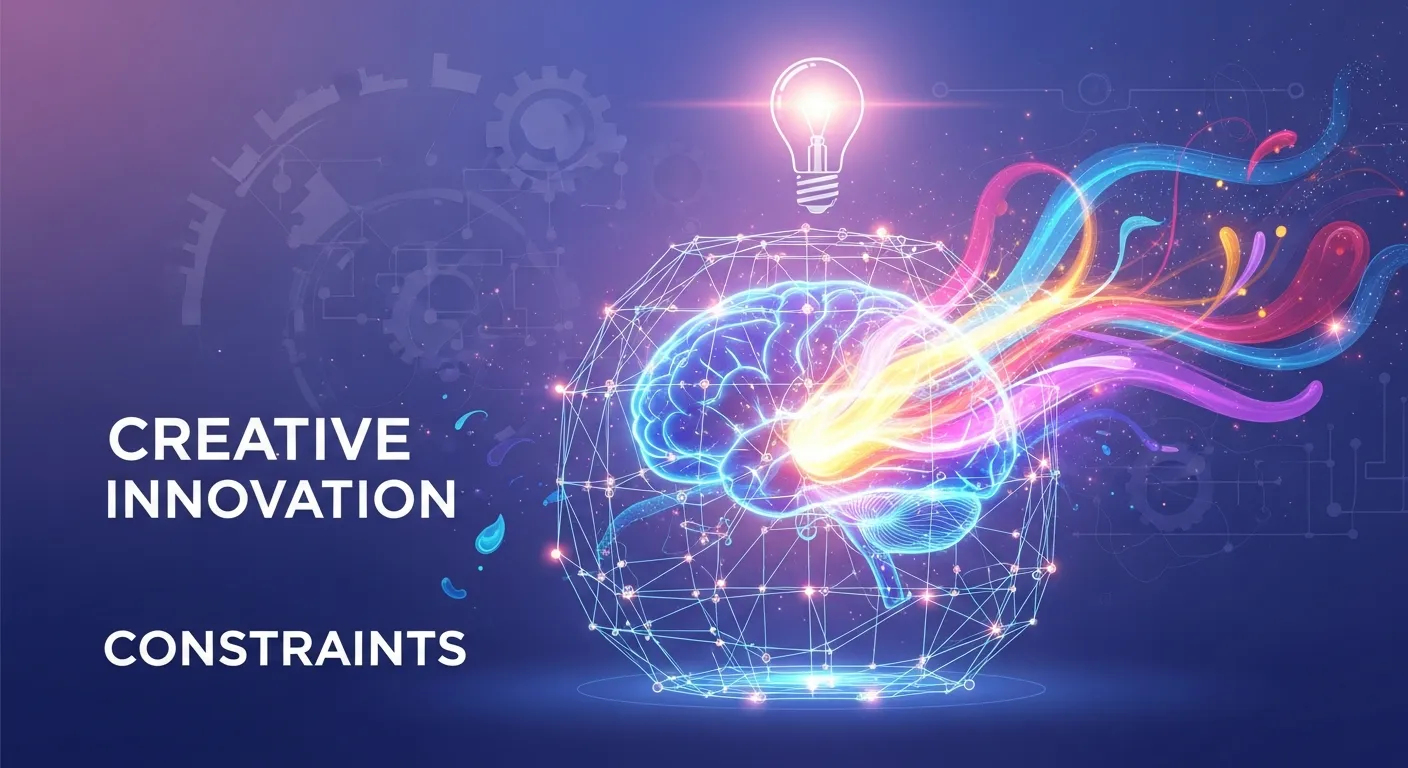
It might seem entirely counterintuitive, but creativity often blossoms under strict constraints. When time, budget, or physical materials are heavily limited, teams must think resourcefully. They uncover highly streamlined approaches that might be completely overlooked when resources are abundant.
To leverage constraint-driven innovation, set incredibly clear boundaries. Assign a fixed budget for early-stage experiments or a very tight deadline for concept development. This pressure encourages the immediate prioritization of high-impact ideas and firmly discourages unnecessary overengineering.
Why Limits Spark Creativity
Constraints force the brain to bypass obvious, expensive, or time-consuming answers. When you cannot throw money at a problem, you must throw creative innovation at it instead. Limitations act as a focusing lens, concentrating your team’s energy on the core of the challenge.
This intense focus frequently results in the most elegant and profitable Creative Breakthrough Solutions. Teams learn to maximize the value of what they have, rather than waiting for ideal conditions that may never arrive.
Rapid Prototyping Techniques
Pair your constraint-based challenges with rapid prototyping to test your core assumptions early. Low-fidelity models—like paper sketches, simple mockups, or basic wireframes—allow teams to visualize concepts very quickly. You can solicit valuable feedback from real users without spending thousands of dollars.
Structured feedback loops help validate core functionality, identify user pain points, and reveal unanticipated uses. Each rough prototype serves as both a critical learning tool and a springboard for immediate refinement. This iterative process is essential for finalizing Creative Breakthrough Solutions.
If you want to understand how to guide these processes effectively, review these excellent problem-solving strategies to streamline your team’s approach. Additionally, exploring concepts beyond problem-solving can elevate your creative innovation methodologies to the next level.
Strategy 4: Integrating Technology to Amplify Human Creativity

Modern innovation relies heavily on technology as a powerful enabler rather than a substitute for human ingenuity. Digital tools streamline workflows, surface hidden data patterns, and connect remote collaborators seamlessly.
Integrating the right technology amplifies your team’s ability to generate Creative Breakthrough Solutions. It removes administrative friction, allowing the human brain to focus entirely on creative innovation and strategic thinking.
AI and Machine Learning as Catalysts
Machine learning algorithms analyze massive amounts of customer feedback and social media sentiment in seconds. They highlight emerging needs, guiding your teams toward the most promising areas for Creative Breakthrough Solutions. Artificial intelligence can act as a brainstorming partner, suggesting divergent ideas based on historical data.
When selecting technology platforms, prioritize tools that align perfectly with your team’s existing workflows. Provide comprehensive training to ensure high adoption rates. However, you must always guard against an overreliance on completely automated processes. The most impactful creative innovation combines data-driven insights with genuine human empathy.
Strategy 5: Cultivating a Growth Mindset and Continuous Refinement
A highly sustainable innovation culture rests firmly on the principle of continuous learning. A growth mindset empowers teams to embrace deep ambiguity and persevere through frustrating setbacks. Leaders nurture this outlook by recognizing intense effort and strategic thinking just as much as successful, profitable outcomes.
You must offer ongoing professional development opportunities for your staff. Workshops on design thinking and courses on emerging technologies build deep corporate resilience. Encourage massive experimentation by establishing dedicated innovation sprints.
Normalizing Productive Failure
Celebrate both your brilliant breakthroughs and the difficult lessons learned from entirely unsuccessful attempts. Reinforce the idea that absolutely every experiment contributes valuable insights to the company. Normalizing productive failure removes the stigma of making mistakes.
When a Creative Breakthrough Solution moves into final implementation, take the necessary time to reflect and refine. Conduct retrospective sessions to evaluate the real-world impact and identify workflow bottlenecks. Use a mix of quantitative metrics and qualitative user insights to form a holistic assessment of your creative innovation efforts.
Strategy 6: Establishing Structured Ideation Frameworks
While creative innovation requires freedom, it also demands structural frameworks to ensure consistency. Establishing specific times, places, and methodologies for ideation guarantees that Creative Breakthrough Solutions become a repeatable process rather than a rare stroke of luck.
Frameworks provide a psychological safety net. When employees know exactly how an idea will be evaluated and tested, they are much more likely to share it.
The Funnel Approach to Creative Innovation
Implementing a funnel approach helps manage the overwhelming volume of ideas generated during divergent thinking. The wide top of the funnel welcomes all concepts, no matter how strange. As ideas move down the funnel, they face increasingly strict criteria regarding feasibility, cost, and alignment with corporate strategy.
This structured progression ensures that only the most robust Creative Breakthrough Solutions reach the final prototyping stage. It saves valuable resources while still encouraging wild, unconstrained creative innovation at the beginning of the process.
Strategy 7: Measuring and Scaling Innovation
The final strategy involves rigorously measuring the success of your creative innovation and scaling it across the enterprise. What gets measured gets managed, and this holds entirely true for Creative Breakthrough Solutions.
You must define clear key performance indicators (KPIs) for your innovation pipeline. Track the time it takes to move an idea from the brainstorming phase to the prototype phase. Measure the return on investment for your most successful Creative Breakthrough Solutions.
Scaling Success Across Departments
Once you identify a highly effective method for generating creative innovation in one department, you must scale it. Share your successful frameworks, tools, and constraints with other teams. Create internal case studies highlighting exactly how specific Creative Breakthrough Solutions transformed the business.
By socializing these victories, you inspire the entire organization to embrace creative innovation. You build a deeply resilient corporate culture capable of solving any future challenge through the relentless application of Creative Breakthrough Solutions.
Frequently Asked Questions
What are Creative Breakthrough Solutions?
Creative Breakthrough Solutions are innovative, transformative answers to complex problems that move beyond incremental improvements. They require divergent thinking, strong collaboration, and a willingness to challenge existing paradigms entirely. Utilizing these solutions ensures massive competitive advantages and long-term organizational success.
How does divergent thinking lead to creative innovation?
Divergent thinking encourages the rapid generation of many diverse ideas without any immediate critical judgment. This expansive process allows teams to uncover highly novel perspectives and unusual connections. It serves as the primary fuel for discovering truly unexpected Creative Breakthrough Solutions.
Why is psychological safety important for innovation?
Psychological safety allows employees to share wild, unconventional ideas without the terrifying fear of ridicule or punishment. When team members feel completely secure, their creative output increases dramatically, fostering a healthy environment. This trust is absolutely essential for sustaining high-level creative innovation over time.
How do constraints actually help generate Creative Breakthrough Solutions?
Strict limitations on time, money, or materials force teams to abandon obvious, expensive, or lazy answers immediately. Constraints demand intense resourcefulness, leading to highly elegant, streamlined, and highly efficient ideas. Embracing limits is a proven method for sparking powerful creative innovation.
What is the role of rapid prototyping in creative innovation?
Rapid prototyping allows teams to build low-cost, fast models to test their core assumptions against reality. It provides immediate, actionable feedback from real users before heavy financial investments occur. This iterative testing is crucial for refining and finalizing Creative Breakthrough Solutions. To master this, learn more about harnessing creative solutions for your business.
How can technology amplify our Creative Breakthrough Solutions?
Technology streamlines collaboration across global teams and utilizes AI to surface hidden data patterns quickly. Digital platforms remove administrative friction, allowing humans to focus entirely on high-level strategic thinking. Properly integrated tools act as a massive force multiplier for corporate creative innovation.
What is the SCAMPER method?
The SCAMPER method is a highly structured brainstorming framework that prompts users to view problems from seven distinct angles. It stands for Substitute, Combine, Adapt, Modify, Put to another use, Eliminate, and Reverse. Walking through these steps guarantees a higher volume of Creative Breakthrough Solutions.
How do we measure the success of creative innovation?
You measure success by tracking specific KPIs like time-to-market, prototype failure rates, and the financial ROI of new ideas. Regular post-mortem reviews help identify exact workflow bottlenecks and areas for immediate improvement. This data-driven approach ensures your Creative Breakthrough Solutions remain highly profitable. Dive deeper into creative solutions techniques to optimize your tracking.
Why should we normalize failure in the workplace?
Normalizing failure removes the intense anxiety that prevents employees from suggesting bold, highly experimental ideas. When failure is viewed as valuable learning data rather than a career-ending mistake, people take intelligent risks. This fearless culture is the breeding ground for massive creative innovation.
How can small teams implement Creative Breakthrough Solutions?
Small teams can easily adopt these strategies by dedicating specific time blocks to structured, divergent brainstorming sessions. They can utilize low-cost rapid prototyping and heavily leverage constraints to their absolute advantage. Agility often makes it much easier for small teams to execute Creative Breakthrough Solutions. Discover more about transforming ideas rapidly.
Conclusion
Creative Breakthrough Solutions are never the product of random chance; they are the result of a highly deliberate, structured approach. By heavily embracing divergent thinking, fostering deeply collaborative environments, and leveraging strict constraints, you establish a powerful framework. Integrating modern technology and sustaining a relentless growth mindset ensures your creative innovation never stalls.
Implementing these seven proven strategies today will accelerate your idea generation and execution massively. You will cultivate a highly resilient corporate culture that thrives on continuous, aggressive improvement. Start applying these vital practices in your very next initiative. Watch closely as your team transforms massive challenges into lucrative opportunities, unlocking entirely new levels of impact and growth through continuous Creative Breakthrough Solutions.
