


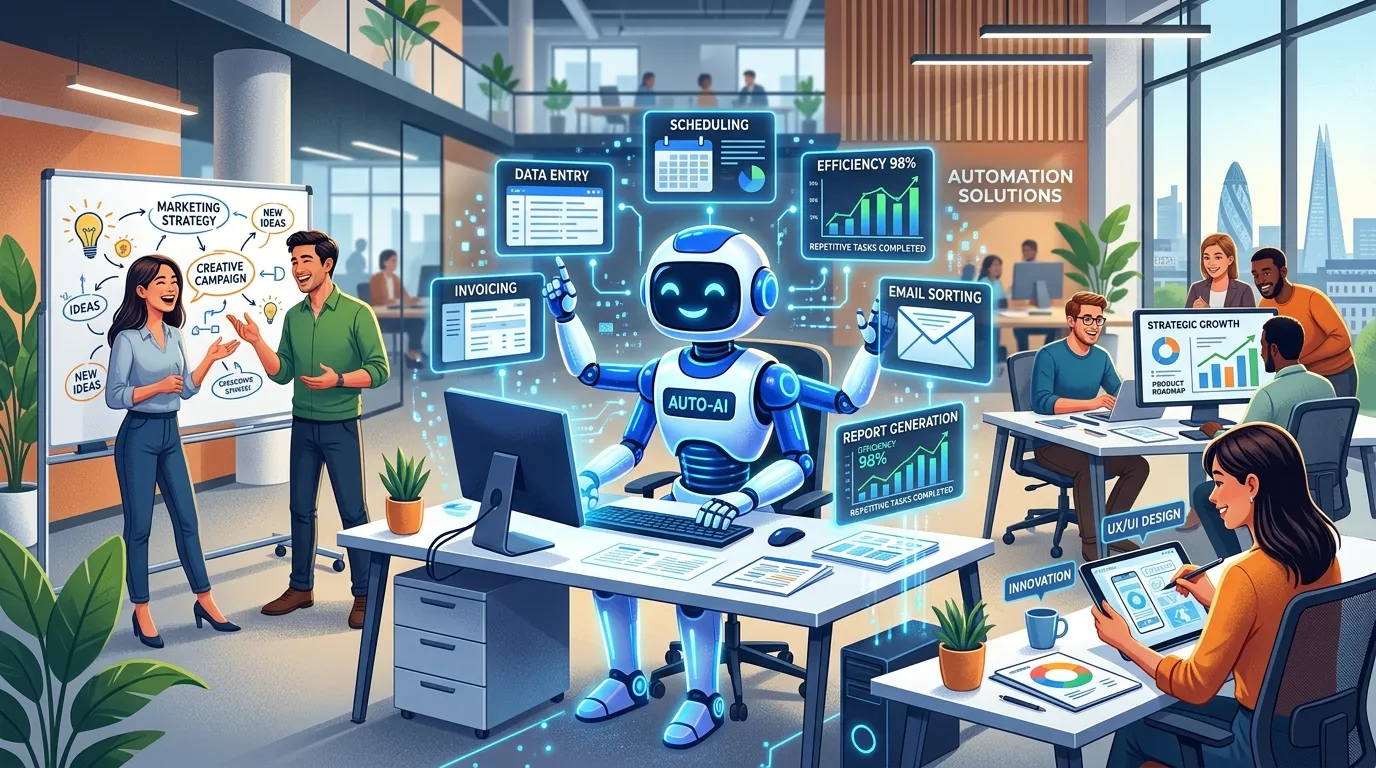
Learn how AI for repetitive tasks helps businesses automate routine workflows, reduce errors, save time, improve productivity, and empower employees through technologies like machine learning, NLP, predictive analytics, and intelligent automation across industries and daily operations.
Every workday, millions of professionals log online only to face a massive mountain of administrative chores. Copying information from one spreadsheet to another, answering the exact same customer questions, and formatting standard documents take up countless hours. These mundane duties drain employee energy and block teams from focusing on the creative, strategic projects that actually drive corporate growth.
Artificial intelligence offers a practical, powerful solution to this universal problem. By automating routine processes, using AI for repetitive tasks gives businesses a proven way to reclaim lost time and dramatically boost overall productivity. Organizations that adopt these advanced technologies consistently find that their employees are happier, their daily operations run more smoothly, and their error rates drop significantly.
This comprehensive guide explores exactly how using AI for repetitive tasks is changing the modern workplace. We will look closely at the underlying technologies making this possible, examine real-world applications across various industries, and discuss the critical steps business leaders must take to implement AI workflow automation successfully.
Understanding the Burden of Routine Work
To fully appreciate the value of AI for repetitive tasks, we must first understand the true cost of manual labor. Routine work fundamentally bottlenecks growth and stifles human innovation.

Defining Manual Processes
Repetitive tasks are predictable, rule-based activities that require little to no critical thinking. They represent the manual processes employees repeat daily, weekly, or monthly without variation. Because these duties follow a strict set of predefined steps, they are incredibly easy to map out, but highly tedious and exhausting for human workers to execute over long periods.
Examples in Daily Operations
You can find these exhausting routines hidden in almost every modern industry. Using AI for repetitive tasks can address numerous daily operations:
- Customer Service: Agents constantly copy and paste responses to common questions about shipping times or password resets.
- Data Entry: Workers manually move thousands of numbers from vendor invoices directly into accounting software.
- Manufacturing: Assembly lines rely on workers doing the exact same physical motion thousands of times a shift to piece together products.
- HR and Recruitment: HR professionals repeatedly screen applicant resumes for keywords and qualifications. AI-powered software can now review hundreds of resumes and identify top candidates in minutes.
- Project Management: Tracking employee hours, updating project boards, and compiling status reports consumes hours each week. Automated AI systems now handle these updates in real-time.
The impact of these manual tasks on a business is surprisingly severe. When highly skilled employees spend half their day on mindless paperwork, their morale plummets. This inevitable boredom leads to disengagement, higher turnover rates, and costly human error. A tired worker typing the wrong digit on a financial report can cost a company thousands of dollars. Furthermore, paying a premium salary for someone to perform basic data entry inflates business costs unnecessarily, which is why AI for repetitive tasks is becoming essential.
Long-Term Impact of Manual Tasks
Beyond mere annoyance, the cumulative effect of repetitive tasks can erode a company’s competitive edge. Over time, hours wasted transfer into missed deadlines, overlooked growth opportunities, and a stagnating workplace culture. Businesses saddled with routine work risk falling behind competitors who leverage AI to enable human creativity and agility.
The Core Technologies Driving AI for Repetitive Tasks
Artificial intelligence, Machine Learning (ML), and Robotic Process Automation (RPA) form the absolute foundation of modern business automation. When implementing AI for repetitive tasks, you are actually leveraging a combination of distinct technologies working in harmony. Each technology brings its own strengths and functionality, and together they transform business processes into seamless, intelligent workflows.
Natural Language Processing (NLP)
Natural Language Processing allows computers to read, understand, and generate human language accurately. NLP helps AI sort through massive volumes of emails or instantly answer customer support tickets. By understanding intent and context, this technology makes AI for repetitive tasks incredibly effective in communication-heavy departments.
AI-based email assistants, for instance, can read incoming messages, classify their urgency, summarize content, and even draft suggested replies. In customer support, NLP allows bots to respond in natural, engaging ways to thousands of simultaneous queries.
Computer Vision
Computer vision technology enables AI systems to interpret visual information from the real world. It can easily scan printed documents and extract text, or carefully inspect products on a factory line for microscopic defects. This application of AI for repetitive tasks replaces the need for humans to stare at screens or conveyor belts all day.
Modern computer vision applications go beyond basic image recognition. AI can evaluate scanned invoices, extract relevant data points, and upload them directly into accounting software. In security settings, computer vision can monitor surveillance feeds and alert teams to abnormal movements or unauthorized access. During quality assurance, cameras and vision algorithms identify production issues earlier and more reliably than manual inspections.
Predictive Analytics
By thoroughly analyzing vast amounts of historical data, AI can accurately forecast future outcomes. This helps automate inventory reordering or schedule preventative maintenance for factory machinery before a breakdown occurs. Using AI for repetitive tasks in planning ensures that businesses never run out of vital supplies.
Predictive analytics is also changing workforce management. By studying past employee performance, attendance, and sales results, AI systems recommend optimal shift schedules, identify training needs, and anticipate resource shortages.
Integration of AI with IoT Devices
The Internet of Things (IoT) and AI work hand in hand to automate even more complex, cross-functional tasks. Smart sensors continuously feed real-time data into AI systems, which can detect anomalies, optimize equipment usage, and trigger maintenance protocols—further reducing the manual workloads.
Top Benefits of AI for Repetitive Tasks
Bringing AI for repetitive tasks into the workplace fundamentally changes how an organization operates. The advantages extend far beyond simple time savings, fundamentally enhancing AI for business productivity.
Massive Speed and Efficiency
The most immediate benefit is a massive increase in the speed and efficiency of daily operations. Software bots process financial transactions and organize complex data in a fraction of the time it takes a human. Using AI for repetitive tasks ensures that work continues around the clock without delays.
Automated document processing, for example, means forms are filed, sorted, and stored instantly. Repetitive customer requests—such as tracking orders or requesting account balances—receive immediate responses through AI-powered systems without human involvement.
Dramatic Error Reduction
Accuracy improves dramatically when you utilize AI for repetitive tasks. Humans naturally get tired, distracted, and bored, which inevitably leads to mistakes. AI systems perform the exact same task perfectly every single time, drastically reducing human error. This precision is especially crucial in heavily regulated fields.
In finance, even a single misplaced decimal can cause significant problems. AI-powered checks catch and flag discrepancies before they escalate. Healthcare providers rely on automated systems to ensure patient records are entered correctly, medication logs are accurately maintained, and billing codes are applied without mistakes.
Substantial Cost Savings
Organizations also see significant cost savings by optimizing their resource allocation. Companies ensure they are paying human workers for their strategic insights rather than their ability to fill out standard forms. The ROI of AI for repetitive tasks becomes obvious when payroll expenses drop while output increases.
- Scalability: AI handles sudden spikes in workload effortlessly without requiring emergency hiring.
- Compliance: Automated systems maintain perfect audit trails for regulatory compliance.
- Employee Satisfaction: Workers feel valued when relieved of mundane administrative burdens.
AI systems excel when businesses scale. If your sales volume doubles overnight, an AI-driven order fulfillment process can handle the increase immediately, ensuring customers experience consistently fast service.
Data-Driven Decision Making
As AI systems process tasks, they collect and analyze data in real-time. This enables organizations to spot workflow bottlenecks, customer pain points, and performance trends quickly, driving continuous improvement. Leveraging AI for repetitive tasks evolves roles into high-value, decision-oriented positions.
Agility and Adaptability
Because AI systems are constantly learning from the data they handle, they become more efficient and accurate over time. Organizations that embrace this adaptability find themselves better equipped to pivot quickly in changing markets—a crucial advantage in today’s fast-paced economy.
Real-World Applications Across Industries
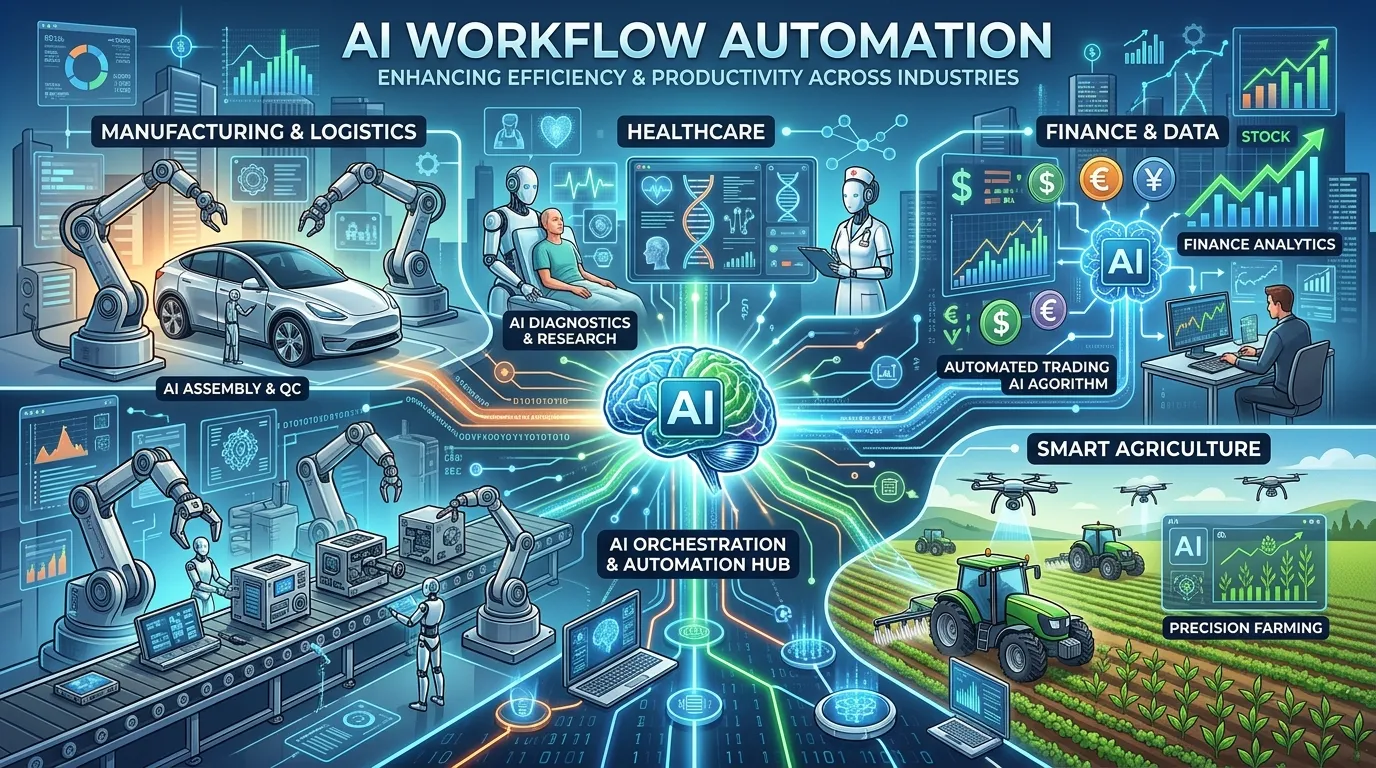
Many industries are already experiencing the incredible benefits of automated workflows. The concept of AI for repetitive tasks is no longer theoretical; it actively improves business outcomes worldwide every single day.
Customer Service Automation
Customer support teams heavily use AI-powered chatbots and virtual assistants to handle repetitive front-line inquiries. When a customer asks about store hours, the NLP-equipped bot provides an instant, accurate answer. This strategic use of AI for repetitive tasks leaves human agents completely available to handle complex, emotionally sensitive issues.
AI chatbots can also handle high volumes of simultaneous conversations across languages and geographies. Sentiment analysis enables bots to gauge customer mood and escalate difficult cases to human supervisors faster, enhancing satisfaction.
Financial Sector Transformation
Financial institutions eagerly deploy AI for repetitive tasks to automate heavy data entry and detect subtle fraud. Algorithms instantly review thousands of credit card transactions per second. If a purchase looks suspicious based on historical patterns, the AI automatically freezes the card entirely, bypassing tedious manual review.
Other banking automations include loan application review, mortgage renewals, form verifications, and regulatory reporting—all powered by intelligent workflows that drastically reduce turnaround times.
Healthcare Innovations
Doctors and nurses often spend much more time updating electronic health records than actually talking to patients. AI tools now listen to patient consultations and automatically draft accurate clinical notes. Additionally, leveraging AI for repetitive tasks assists with administrative duties like complex medical billing and patient scheduling.
Healthcare systems also use AI image recognition to analyze x-rays and other diagnostic scans, flagging abnormalities faster than human radiologists. Scheduling systems powered by AI optimize appointment slots based on patient urgency and provider availability.
Manufacturing and Quality Control
Factories extensively use AI to manage quality control and product assembly lines. Cameras equipped with computer vision scan products moving rapidly down a conveyor belt. If an item has a scratch, the AI instantly flags it for removal. Applying AI for repetitive tasks in manufacturing is much faster and more reliable than the human eye.
In addition, predictive maintenance powered by AI analyzes equipment data and recommends repairs before breakdowns occur, saving money and downtime.
Retail and E-commerce
AI is redefining inventory management, demand forecasting, and order fulfillment. Automated replenishment systems monitor stock levels and place orders when thresholds are met. Personalized recommendation engines use AI to send tailored offers and emails, all powered by intricate workflow automation.
Human Resources
AI automates repetitive processes including resume screening, interview scheduling, and employee onboarding. Smart platforms identify skill gaps within teams and suggest custom training programs, maximizing workforce productivity.
Implementing AI Workflow Automation
To successfully deploy AI for repetitive tasks, organizations need a highly structured, deliberate approach. Rushing into implementation without a strategy often leads to wasted resources and employee frustration.
Auditing Your Current Operations
Start by deeply auditing your daily operations. Look closely for operational bottlenecks and highly repetitive, rule-based tasks that consume a large portion of your team’s valuable time. Good candidates for repetitive task automation include invoice processing, daily email sorting, and basic spreadsheet data entry.
|
Task Category |
Complexity Level |
Automation Potential |
Estimated Time Saved |
|---|---|---|---|
|
Data Entry |
Low |
Very High |
15+ hours/week |
|
Email Sorting |
Low |
High |
10+ hours/week |
|
Report Generation |
Medium |
High |
12+ hours/week |
|
Client Onboarding |
Medium |
Medium |
8+ hours/week |
|
Scheduling |
Low |
High |
5+ hours/week |
|
Inventory Update |
Medium |
High |
7+ hours/week |
Expanding your internal audit involves interviewing stakeholders, mapping every workflow, and using process mining software to visualize where time and money are being lost. The more granular your understanding, the easier it is to select the best AI for repetitive tasks.
Selecting the Right AI Automation Tools
The software market is currently flooded with robust AI platforms. You must carefully evaluate vendors based on your specific operational needs, budget constraints, and internal technical capabilities. Look for reliable solutions that offer robust security, intuitive user interfaces, and excellent customer support.
Explore top software options to find the perfect fit for your workflow.
Remember to check user testimonials, independent reviews, and integration capabilities with your existing tech stack.
Key Features to Consider
- Ease of Integration: Does the tool work with your current accounting, CRM, and ERP systems?
- Customization: Can you tailor workflows to suit your organization’s unique needs?
- Reporting: Does the platform provide actionable analytics?
- Support: Is customer support accessible and knowledgeable about AI for repetitive tasks?
Integrating with Existing Systems
Using AI for repetitive tasks should fit seamlessly into your current tech stack. Work closely with your internal IT department to ensure the new AI automation tools can pull data from your existing CRM, ERP, and communication platforms without disrupting daily company operations.
API-first platforms and robust middleware make it easier than ever to connect AI to diverse systems, but strong IT governance and change management protocols are crucial for success.
Change Management and Staff Training
Rolling out AI workflow automation is as much about people as it is about technology. Comprehensive staff training is essential to encourage adoption and help employees understand how AI for repetitive tasks can free them to focus on higher-value responsibilities.
Communicate openly about the goals of automation, offer workshops, and celebrate early wins. Ongoing support, feedback loops, and transparent performance metrics keep morale up and resistance low.
Overcoming Challenges in AI for Business Productivity
While the advantages are abundantly clear, adopting artificial intelligence is not without significant hurdles. Leaders must navigate several prominent obstacles to ensure a smooth, profitable transition to automated workflows.
Addressing Security and Privacy
Data privacy and digital security represent major corporate concerns. AI models require vast amounts of information to learn effectively. When deploying AI for repetitive tasks using sensitive customer details, companies must implement strict safeguards to prevent breaches and guarantee full compliance with privacy laws.
Consider working with vendors who offer end-to-end encryption, strong access controls, and regular vulnerability assessments. Document your data flow and privacy protocols, update policies as new threats emerge, and train staff to avoid common cyber risks.
Maintaining Human Oversight
Human oversight remains absolutely necessary when deploying AI automation tools. AI operates incredibly fast, but it inherently lacks human common sense. Businesses must establish mandatory review processes where skilled humans actively monitor the AI’s output and intervene appropriately when necessary.
Develop escalation paths and exception management protocols for unusual situations, and periodically audit AI system decisions to ensure ongoing accuracy and fairness.
Overcoming Employee Resistance
Successfully deploying AI for repetitive tasks requires addressing employee fears about job loss. Leaders should highlight opportunities for upskilling and emphasize how automation enhances roles rather than replaces them. Pilot programs, open feedback forums, and recognition of automation successes help drive cultural buy-in.
The Future of Work with AI

The global workplace is undergoing a fundamental, irreversible shift. Moving forward, highly successful organizations will view artificial intelligence as a vital collaborative partner rather than just a software tool. Using AI for repetitive tasks will simply become the baseline standard for business operations.
Emerging Trends in AI for Repetitive Tasks
Several developments are rapidly changing the automation landscape:
- Hyper-automation: Combining RPA, AI, and process mining for full end-to-end automation.
- No-Code/Low-Code Tools: Putting automation capabilities directly into the hands of non-technical staff.
- AI-Powered Decision Making: More businesses are trusting AI to make and implement simple decisions, such as routine approval workflows or supply chain management.
- Edge AI: Deploying intelligent automation directly on local devices for real-time data processing and responsiveness.
The evolution of human roles will center heavily around soft skills. Empathy, complex negotiation, creative problem-solving, and strategic leadership will become more valuable than ever before. Employees will transition smoothly from being manual processors of information to being reviewers and strategic managers of AI systems.
Artificial intelligence holds immense, undeniable power to transform the modern workplace. By successfully taking over mundane chores, using AI for repetitive tasks allows businesses to operate with unprecedented speed and accuracy. Evaluate your current workflows today, identify areas ripe for automation, and begin exploring the AI tools that can propel your business forward.
Frequently Asked Questions
What exactly is AI for repetitive tasks?
AI for repetitive tasks involves using artificial intelligence software to handle predictable, rule-based administrative chores automatically. This technology safely takes over mundane duties like manual data entry, basic email sorting, and standard customer service responses. By automating these routines, it frees human employees to focus entirely on creative and strategic business goals.
How does AI workflow automation save businesses money?
By implementing AI for repetitive tasks, companies drastically reduce the manual labor hours required for basic administrative functions. This significant optimization allows businesses to scale their operations upward without constantly hiring expensive new administrative staff. It also severely cuts down on costly human errors that cause financial discrepancies.
Will AI for repetitive tasks replace human employees entirely?
No, AI is designed strictly to eliminate tedious chores, not to replace valuable human critical thinking or emotional intelligence. While it handles basic data processing, companies still desperately need humans for strategic planning, complex client relationship management, and creative problem-solving. It acts as a powerful collaborative tool rather than a total replacement.
What are the best tools for repetitive task automation?
The best tools generally depend on your specific industry, ranging from advanced RPA software to simple customer service chatbots. You should carefully look for platforms that integrate seamlessly with your existing software stack and offer strong data security. Learn more about implementing these systems to ensure you choose the exact right fit for your unique business needs.
Is it difficult to implement AI for business productivity?
Implementing AI for repetitive tasks requires careful upfront planning, but modern software platforms are becoming incredibly user-friendly. Most enterprise tools now offer simple drag-and-drop interfaces that do not require deep coding knowledge to set up. With proper employee training, integration into daily workflows becomes a very smooth process.
Can small businesses use AI for repetitive tasks?
Absolutely, small businesses benefit immensely from AI automation tools because they often operate with very limited human resources. Automating basic routines like appointment scheduling, social media posting, and client invoicing allows small teams to compete with much larger corporations. Many AI platforms offer scalable pricing models perfectly suited for modest budgets.
How does AI reduce human error in the workplace?
Humans naturally become tired and distracted when performing the exact same tedious action for hours, which inevitably leads to typos and mistakes. AI for repetitive tasks follows programmed rules flawlessly, executing the process exactly the same way every single time without fatigue. This incredible consistency ensures data accuracy across all your business platforms.
Are there privacy risks with AI workflow automation?
Yes, processing sensitive client data through third-party AI platforms carries inherent digital security risks that must be managed. Businesses must ensure their chosen AI automation tools comply with major data protection regulations like GDPR or HIPAA. Maintaining strict access controls and encrypting data prevents unauthorized access and secures your automated workflows.
How do employees generally react to AI automation tools?
Initially, employees may experience valid anxiety regarding job security when AI for repetitive tasks is introduced to the office. However, once they realize the technology eliminates their most boring, tedious daily chores, acceptance and job satisfaction typically skyrocket. Transparent communication from leadership regarding the tool’s true purpose is absolutely vital for smooth adoption.
What tasks should I automate first with AI?
You should begin by targeting the most time-consuming, highly predictable, and rule-based tasks in your daily operations. Excellent starting points for AI for repetitive tasks include standard invoice processing, basic customer FAQ responses, and CRM data entry. Starting with these simple processes provides quick wins and proves the technology’s immediate value to your team.
By focusing relentlessly on smart automation and a human-first philosophy, organizations can unlock the full potential of AI for repetitive tasks, empowering lasting competitive advantage and a more fulfilling workplace for everyone.
